Development, Environment, Disputes Resolution
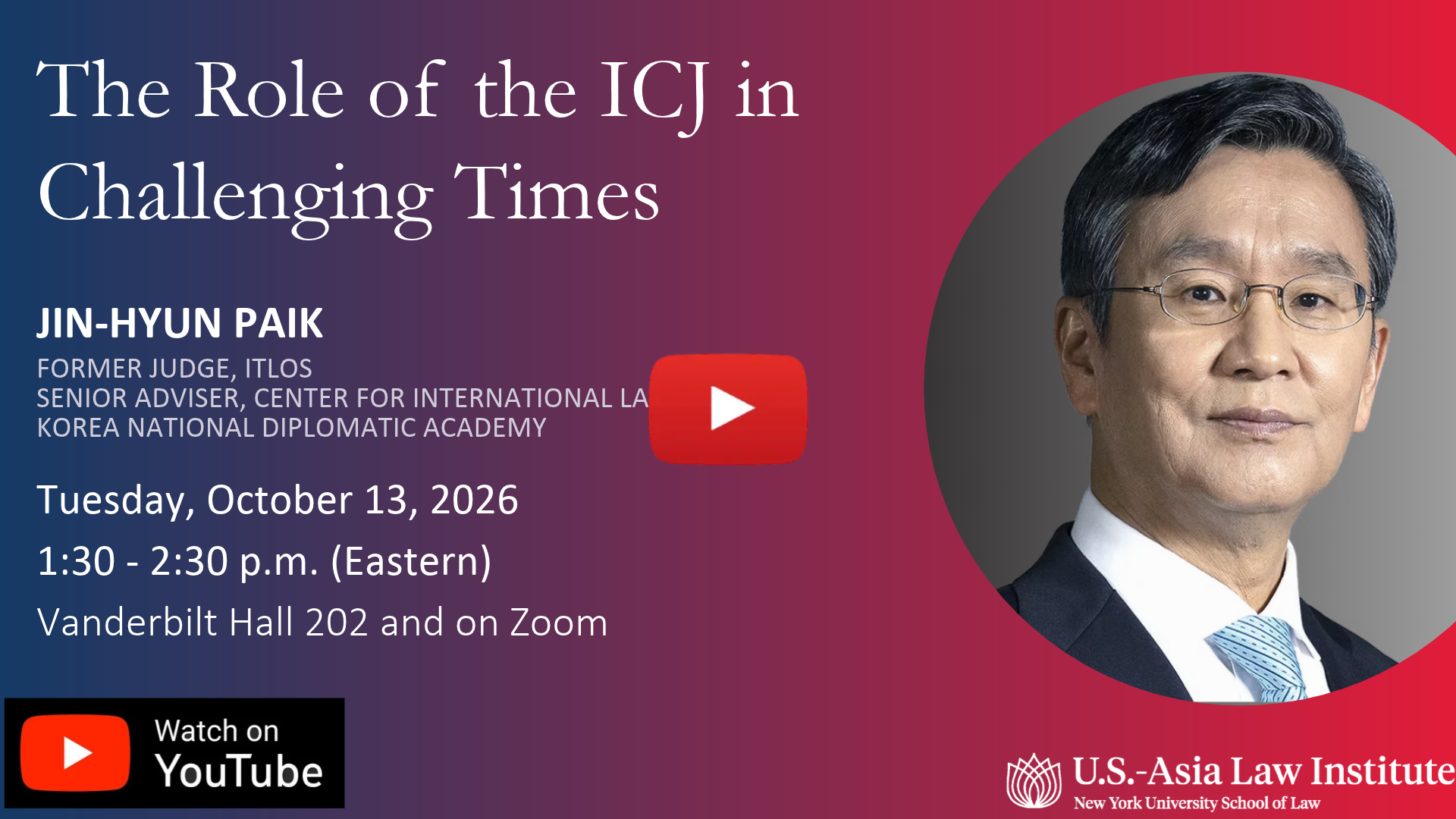
In recent years, amid intensifying geopolitical tensions and conflicts, the effectiveness of international law and particularly the UN Charter’s obligation that all states settle their disputes peacefully is widely contested. The International Court of Justice (ICJ), by contrast, has attracted more litigants than ever before as well as high profile requests for advisory opinions that have drawn the participation of unprecedented numbers of states seeking to participate in the judicial process. While the world’s attention focuses on the election of a new UN Secretary-General, the same political organs responsible for that selection – the UN General Assembly and Security Council – are engaged in electing or re-electing a number of judges to a Court that is now seen as the favored international venue for ‘strategic litigation.’ One of those candidates, Paik Jin-Hyun, a former president of the International Tribunal for the Law of the Sea (ITLOS) and an experienced arbitrator for international disputes, will share his views on why the judicial interpretation of international law remains popular when that law is itself under severe challenge.
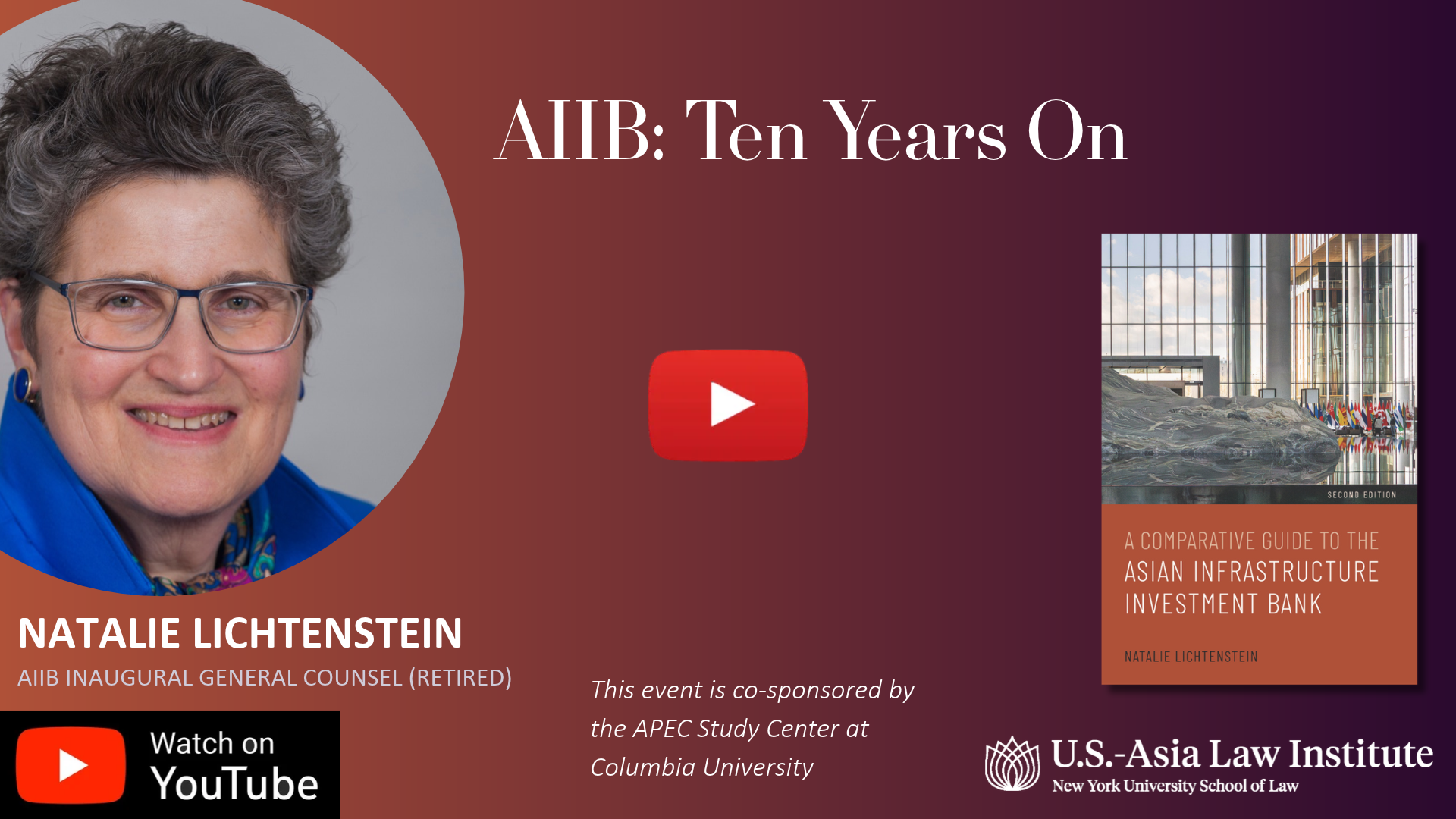
As the Asian Infrastructure Investment Bank (AIIB) launched in 2016, many wondered how this new China-led multilateral development bank (MDB) would fare. Natalie Lichtenstein, AIIB’s founding lawyer takes a look at AIIB in context, surveying 100 years of MDB legal genealogy. What does AIIB’s first decade tell us about the combination of heritage and innovation in AIIB’s 21st century charter?
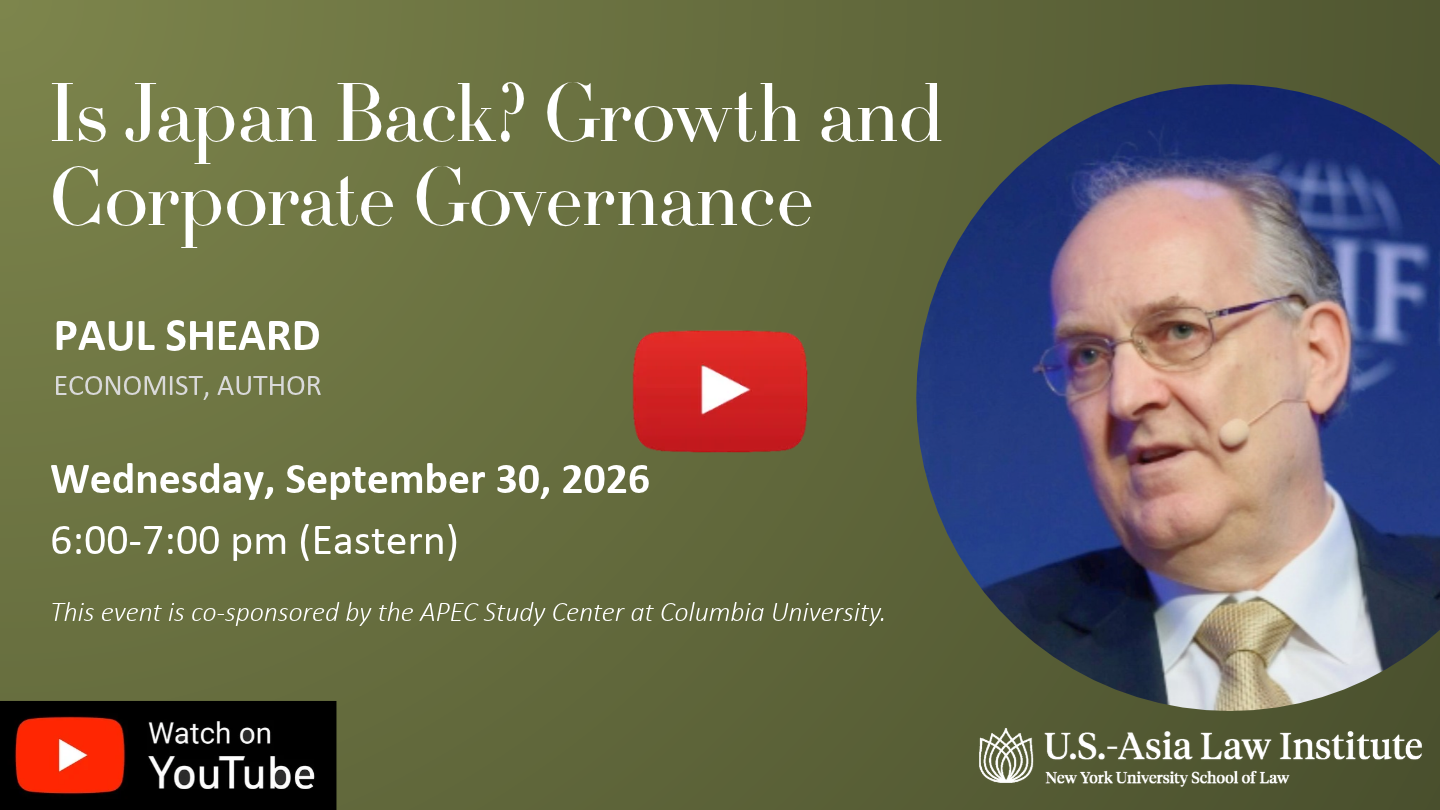
Dr. Paul Sheard will join Professor Bruce Aronson for a discussion about Japan’s economic growth strategy and corporate governance, with a particular focus on the Takaichi Cabinet’s growth agenda, sometimes called “Sanaenomics,” and how it compares with “Abenomics.” They will also discuss how Japan’s broader strategic priorities are evolving in response to shifting domestic and global economic conditions.
Please note that the location of this event has changed to Furman Hall 212
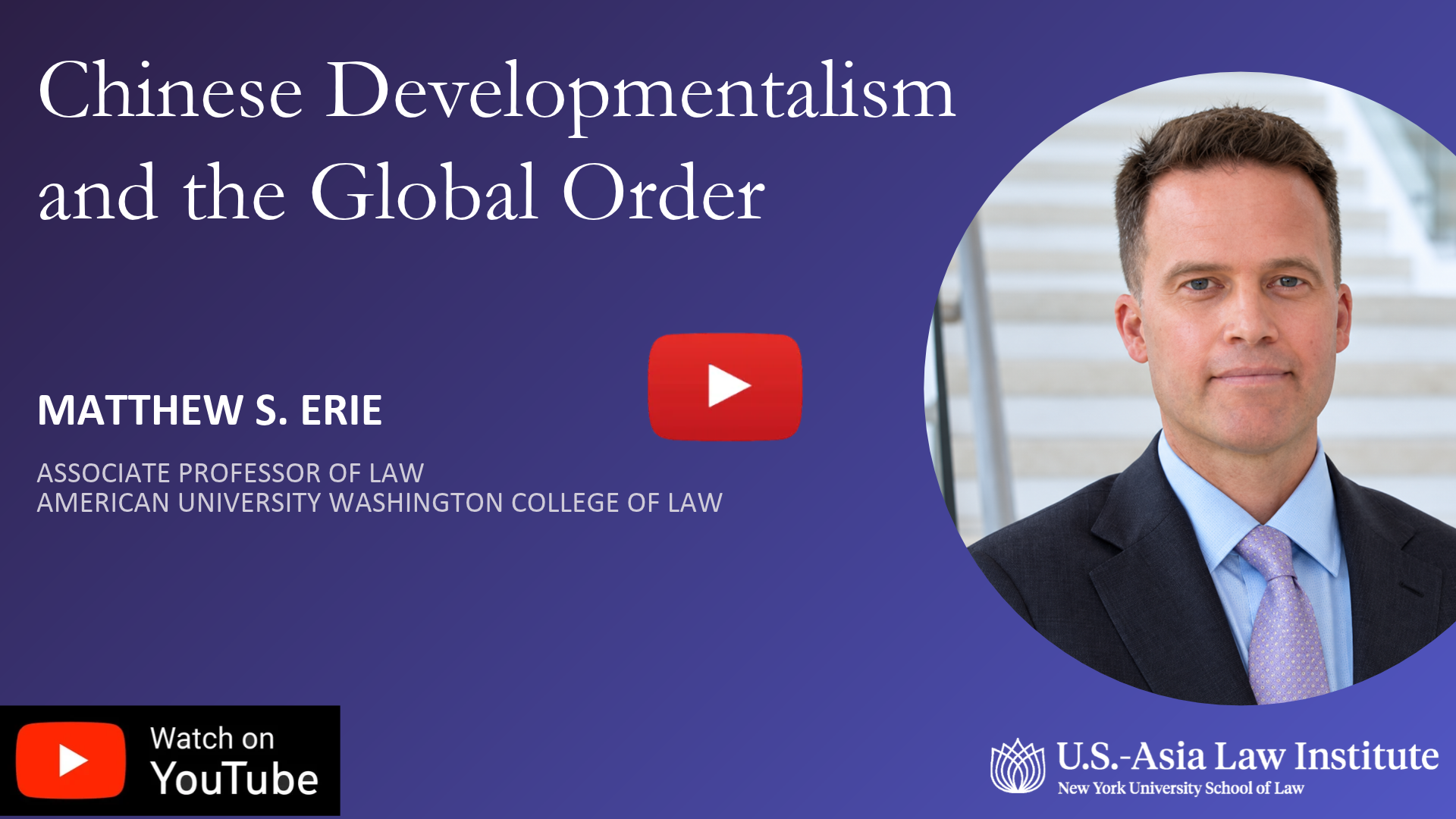
Contemporary trends suggest a sea change in the international order as the US reverses its longstanding commitments to free trade and liberal democracy. Based on a forthcoming book titled Chinese Developmentalism in the Global Legal and Economic Order, co-edited with Jacques deLisle and Jaclyn Neo, our speaker, Matthew Erie, says that China promotes a novel ordering they call “Chinese developmentalism,” which favors state-led economic growth, industrial policy, technological innovation, and illiberal governance. Chinese developmentalism is complex and still evolving, but Erie says while its aspirations are far-reaching, the magnitude and direction of its impact are far from inevitable.
We find ourselves at a remarkable moment in global environmental governance. China actively supports green development on the global stage, while the US under the Trump administration rejects the Paris Agreement and actively opposes the development of renewable energy and electric vehicles. Professor Alex Wang of the UCLA School of Law will introduce his new book, Chinese Global Environmentalism, which examines how China came to embrace green development and how it promotes a developmental form of environmentalism that differs from Western conceptions.

Singapore now ranks with Paris and London among the top-3 venues for international arbitration, despite being much newer on the scene. Lucy Reed, President of the Singapore International Arbitration Centre Court, a prominent arbitrator and international lawyer, will explore the reasons, which include government commitment, supportive legislation, first-rate courts, Maxwell Chambers, SIAC, and a truly international outlook.

China’s legal service sector is growing rapidly, including not only commercial law offices but publicly funded legal aid and innovative free legal advice platforms. At the same time, the regime has largely suppressed the country’s human rights lawyers. What is going on? Hualing Fu, dean of the law faculty at the University of Hong Kong and visiting professor at NYU School of Law, will share his research into an emerging new sector that he calls “public legal services,” which the party-state is developing in order to ensure that social disputes are resolved speedily in line with regime interests. In the process, Chinese lawyers may be transitioning backward from legal professionals to state legal workers.

The Constitutional Courts of South Korea and Taiwan have been thrust into the spotlight in recent weeks as they are asked to arbitrate bitter power struggles between the elected branches – power struggles in which the justices themselves have been targeted. Two eminent constitutional scholars – Chaihark Hahm of Yonsei Law School and Jiunn-rong Yeh of National Taiwan University – will explain the background to the current crises and reflect on the role of courts in protecting democracy at times of deep partisan divisions.

Beginning in the 1950s, Japan’s Overseas Development Assistance (ODA) has been an important instrument for Japanese diplomacy. However, this cold war strategy has evolved over the past two decades, in large part due to the rise of China, to include both national security challenges and the promotion of universal values. How will Japanese ODA policy respond to the current challenge of striking a balance between promoting universal values and avoiding offense to recipient governments? Can Japan play a special role as the developed world’s “ambassador” to the Global South?

The National Security Law, which was imposed on Hong Kong in 2020, takes precedence over local law and has profoundly affected civil liberties and the right to fair trial. Does international law no longer matter in Hong Kong? Carole Petersen, professor of law at the University of Hawaii at Manoa, finds that in cases not affecting Beijing’s core interests, local judges still rely on international and comparative sources and still rule against the local Hong Kong government. This has been particularly evident in strategic litigation to advance the rights of the LGBT community. Petersen concludes that if the local government is serious about trying to rebuild Hong Kong’s international reputation, then it should accept and fully implement these rulings.

Private law scholars have viewed Anglo-American common law as the core infrastructure of modern capitalism the world over. But what happens when rising powers like China with very different legal and political systems begin investing abroad on a vast scale? Our speaker, Matthew Erie, associate professor at the University of Oxfordr esponded to this question by launching a six-year project, called China, Law, and Development, and inviting scholars around the world to participate in gathering empirical evidence about the legal underpinnings of China’s worldwide investments, and whether or how China has disrupted prior assumptions about the relationship between law and development. In this talk, he will introduce the concept of “law as infrastructure” to make sense of the strategies and challenges of the People’s Republic of China. Rather than a “clash of civilizations” or a world remade in China’s image, law as infrastructure points to a process of layering, assembling, and bundling different laws and legal regimes including new law that is integrated within existing frameworks, epistemic communities, and institutions, as well as the creation of new infrastructures in emerging sectors such as renewable energy.

An obscure reef in the South China Sea has become the latest flashpoint in China’s long-running campaign to dominate the South China Sea. Since last summer, the Chinese Coast Guard has repeatedly employed water cannons, lasers, and acoustic weapons and rammed Philippine Navy and Coast Guard vessels to prevent them from resupplying military personnel positioned at Second Thomas Shoal. Jay Batongbacal, a lawyer and professor at the University of the Philippines College of Law, will discuss how this tiny maritime feature became a potential conflict site, why a 2016 ruling by an international tribunal in the Philippines’ favor has not ended the dispute, and how international law can continue to be effective in the face of Chinese attacks.

Chinese Communist Party leader Xi Jinping has recently started highlighting the importance of promoting “foreign-related rule of law,” a new category of law that knits together Chinese and international law to govern China’s offshore activities. One place to look for foreign-related rule of law in action is in Chinese-invested overseas special economic zones, which some foreign scholars view as extraterritorial zones under Chinese power and law.

Professor Hyun Bang Shin will share his analysis from years of studying urban development and anti-gentrification movements in Asian cities, especially those in South Korea, China, and Southeast Asia.
Many debates exist about the nature of China’s engagement with the international “rule-based” order and whether the arrangements underpinning the Belt and Road Initiative (BRI) will be formalized into hard laws. Our speakers will demonstrate how China’s provincial governments re-interpret the BRI to generate a new international economic agenda largely driven by regional interests.
States take the center stage at global climate negotiations, but corporations sit squarely in the crosshairs as contributors to climate change, casualties of the fallout, and indispensable participants in any response. Governments, investors, and publics across Asia-Pacific are increasingly demanding that corporations do more to address the climate crisis.
Rising sea levels due to climate change are affecting the livelihoods of millions of persons in Asia-Pacific. While engineers develop physical adaptations, the UN’s International Law Commission (ICL) has been studying needed adaptations to international legal frameworks in order to protect the status and rights of affected states.
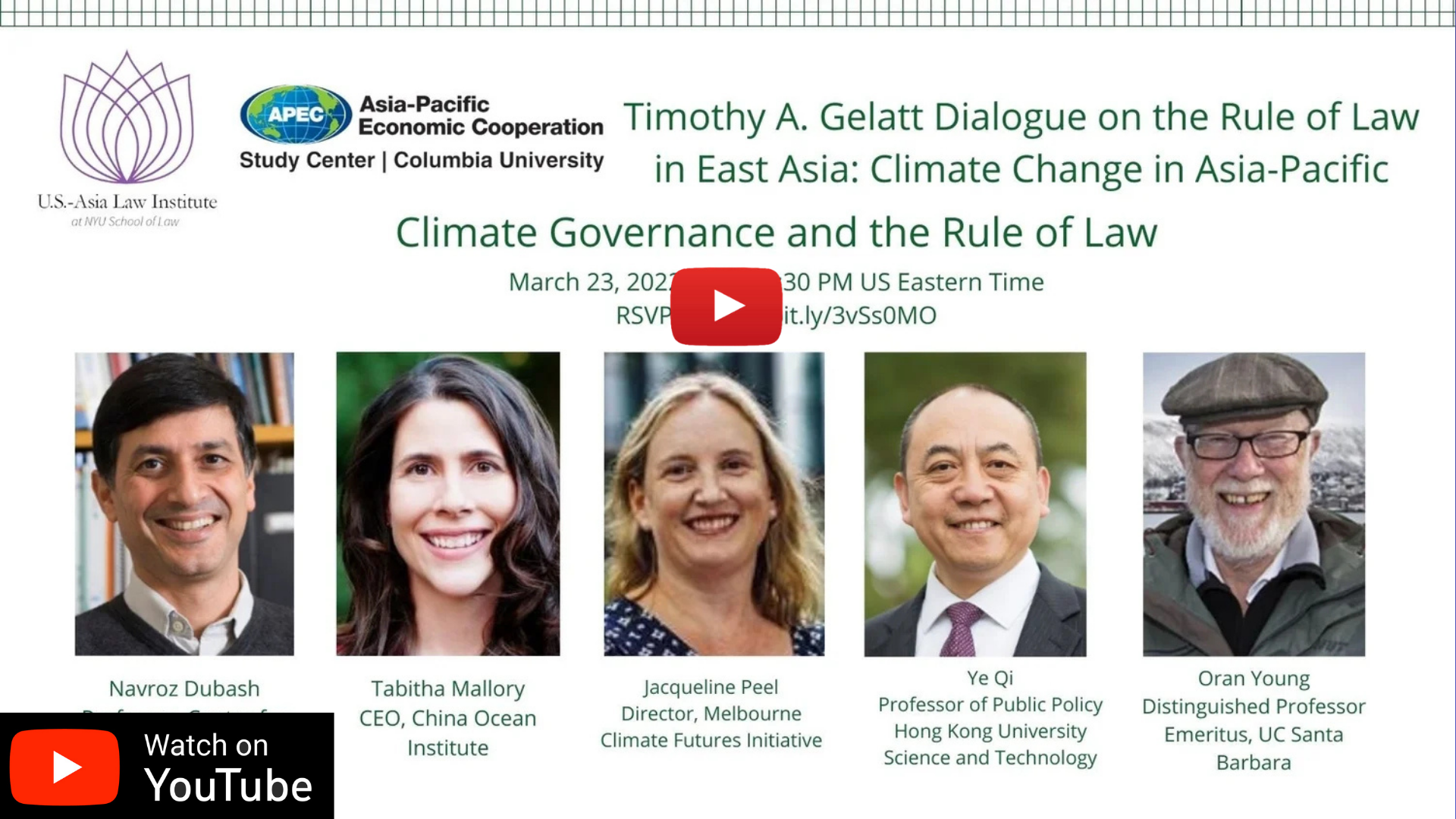
The latest report from the UN Intergovernmental Panel on Climate Change (IPCC) confirms that the damage to Earth’s ecosystems from rising temperatures is mounting far more rapidly than the global community has been able to respond – at least, so far. With a comprehensive international treaty seemingly out of reach, what are other options for mobilizing action?

Twenty years after China joined the World Trade Organization (WTO), the US and other member states are questioning China’s commitment to the institution and to the multilateral liberal trading order.

Guest speaker Jonathan Odom will join NYU Law School Adjunct Professor Peter Dutton to discuss the fast-moving events in the South China Sea and maritime East Asia. They will discuss the conflicting claims to water space, resources, and islands and ask whether international law can be invoked to reduce tensions.