Promoting Rule of Law and Human Rights in Asia
The U.S.-Asia Law Institute serves as a bridge between Asia and America, fostering mutual understanding on legal issues, and using constructive engagement with our partners to advocate for legal reform.
New and Notable
Publications
After four years of deriding President Biden’s energy policies as “industry-killing, jobs-killing, pro-China, and anti-American,” Donald Trump is executing a radical pivot. He is withdrawing from the Paris Agreement, revoking financial commitments made under the UN Framework Convention on Climate Change, terminating USAID-funded initiatives in renewable energy, conservation, and climate adaptation, and decelerating decarbonization at home — to cite just a few early moves. Railla Puno takes inventory and analyzes the known and anticipated impacts.
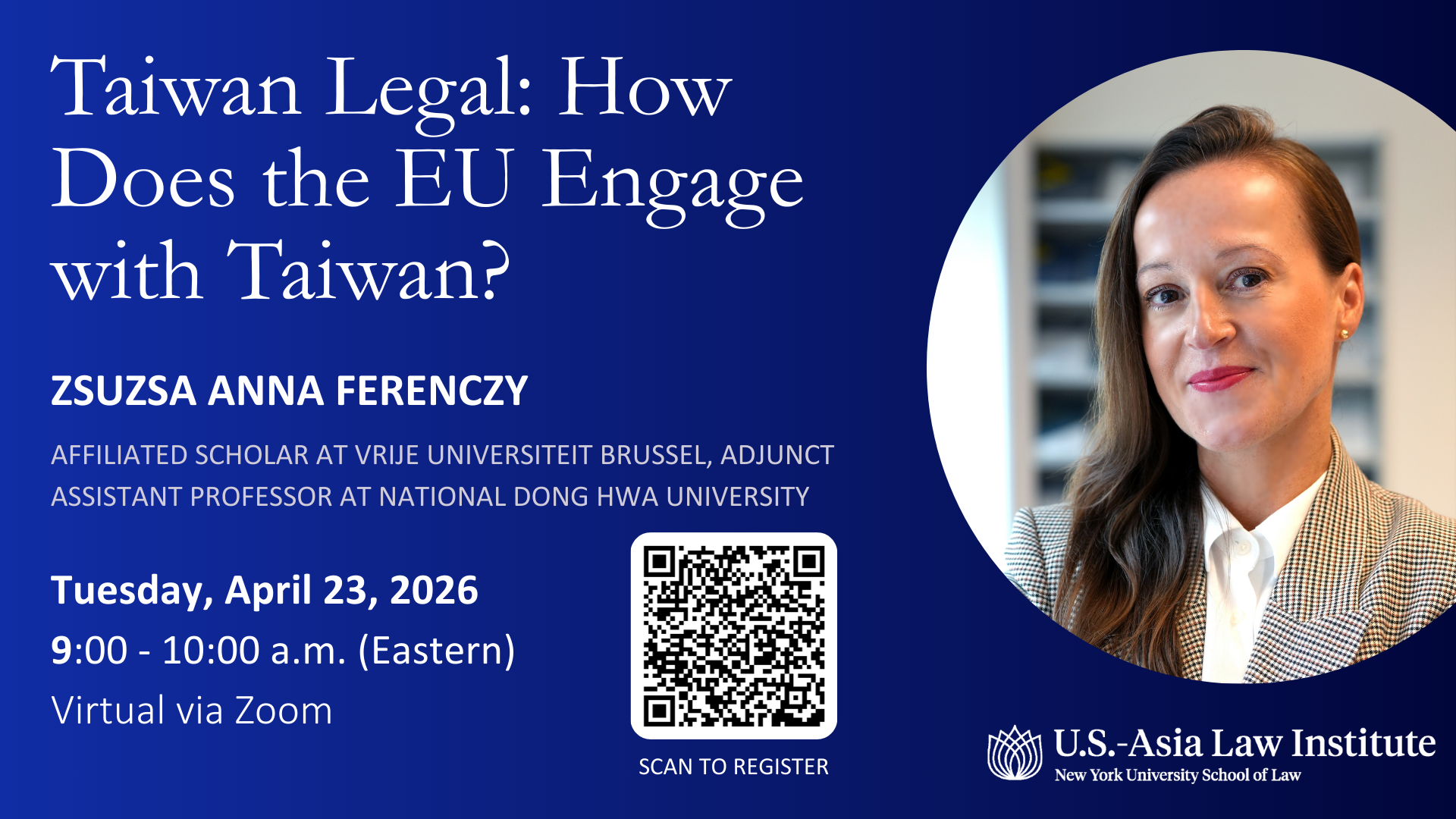
One of the most complicated issues in contemporary international relations is the status of the self-governing island of Taiwan and its government in Taipei, formally called the government of the Republic of China. During the 2024-2025 academic year, the U.S.-Asia Law Institute is hosting a series of speakers to address Taiwan’s status. We began with a talk by Richard Bush, a nonresident senior fellow at The Brookings Institution who led US engagement with Taiwan from 1997 to 2002 as chairman and managing director of the American Institute in Taiwan. In his October 30, 2024 online talk at NYU Law, Bush explained the genesis and significance of the 1979 Taiwan Relations Act.
Institute News
February 23, 2025-March 1, 2025
Western governments and the UN High Commissioner for Refugees condemn Thailand’s deportation of 40 Uyghur asylum seekers to China; a Hong Kong court convicts former lawmaker Lam Cheuk-ting of rioting during the 2019 Yuen Long MTR incident and sentences him to 37 months in prison; a Tokyo court finds a former Chinese employee of Japan’s state-run research body guilty of giving confidential data to a Chinese company; South Korea’s Constitutional Court wraps up its hearings in the impeachment trial of President Yoon Suk Yeol; a Taiwan court acquits a retired rear admiral and three other defendants of charges that they accepted money from China to develop spy networks in Taiwan.
February 16, 2025-February 22, 2025
A coordinated operation by the Thai, Chinese, and Myanmar governments achieves the release of hundreds of foreign nationals forced to work in telecoms fraud operations in Myanmar; Hong Kong’s Democratic Party studies measures to dissolve itself; a court in Japan convicts a would-be assassin of former Prime Minister Fumio Kishida and sentences him to ten years in prison; criminal proceedings begin against South Korean President Yoon Suk Yeol as he continues to battle impeachment; Taiwan praises and China condemns the US Department of State for removing a statement on its web site that it does not support Taiwanese independence.
February 9, 2025-February 15, 2025
China’s Supreme People’s Court and Supreme People’s Procuratorate issue new typical cases; the chair of the Hong Kong Journalists Association sues her former employer, the Wall Street Journal; President Donald Trump’s comments that Nippon Steel would invest in US Steel instead of pursuing a takeover reportedly took both companies by surprise; South Korea’s opposition-led National Assembly calls on Acting President Choi Sang-mok to completely fill the bench of the Constitutional Court as it hears the impeachment trial of President Yoon Suk Yeol; Taiwan’s opposition-controlled legislature votes to impose new requirements to initiate the recall of elected officials.
Program on International Law & Relations in Asia

Search our website