Promoting Rule of Law and Human Rights in Asia
The U.S.-Asia Law Institute serves as a bridge between Asia and America, fostering mutual understanding on legal issues, and using constructive engagement with our partners to advocate for legal reform.
New and Notable
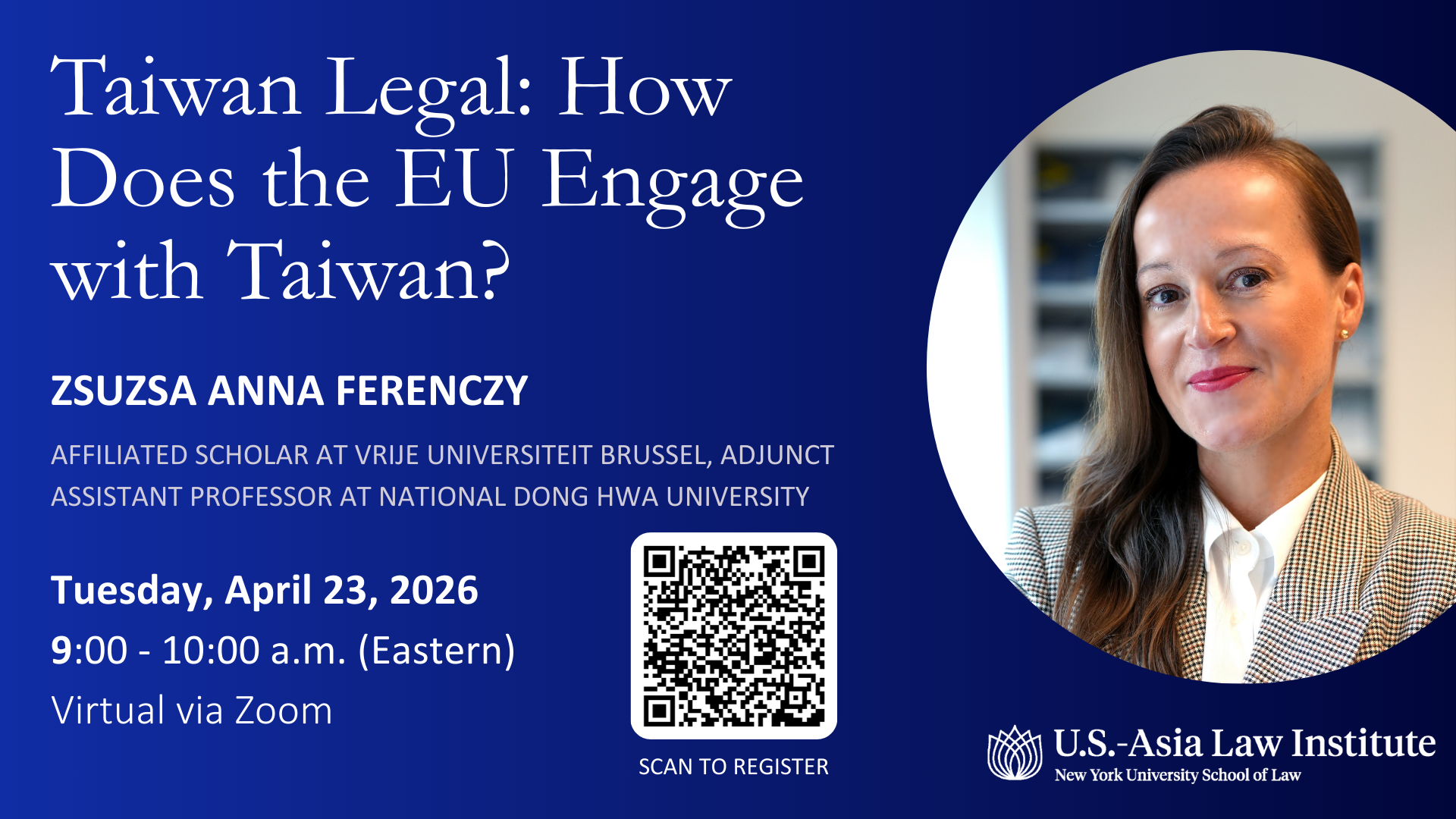
One of the most complicated issues in contemporary international relations is the status of the self-governing island of Taiwan and its government in Taipei, formally called the government of the Republic of China. During the 2024-2025 academic year, the U.S.-Asia Law Institute is hosting a series of speakers to address Taiwan’s status. We began with a talk by Richard Bush, a nonresident senior fellow at The Brookings Institution who led US engagement with Taiwan from 1997 to 2002 as chairman and managing director of the American Institute in Taiwan. In his October 30, 2024 online talk at NYU Law, Bush explained the genesis and significance of the 1979 Taiwan Relations Act.
Beginning in the 1950s, Japan’s Overseas Development Assistance (ODA) has been an important instrument for Japanese diplomacy. Its initial focus on economic development in Asia was characterized as being both nonmilitary and nonpolitical. However, this cold war strategy has evolved over the past two decades, in large part due to the rise of China, to include both national security challenges and the promotion of universal values. How will Japanese ODA policy respond to the current challenge of striking a balance between promoting universal values and avoiding offense to recipient governments? Can Japan play a special role as the developed world’s “ambassador” to the Global South? Hiroaki Shiga, a professor at Yokohama National University, will join NYU Law Adjunct Professor Bruce Aronson in a conversation on the evolution and current challenges of Japan’s ODA policy
In September, the federal court in Brooklyn unsealed an indictment against Linda Sun, a former aide to New York Governor Kathy Hochul, for failing to register as a foreign agent of the government of the People’s Republic of China and the Chinese Communist Party. Xuan W. Tay writes that while the art of influence is inseparable from the work of diplomacy, international law does not give PRC officials free rein to carry out influence operations inside other countries.
In 2019, Matthew S. Erie, an associate professor of modern Chinese studies and member of the law faculty at Oxford University, began an ambitious project called China Law and Development in an effort to understand the role that law plays, directly or indirectly, in China’s outbound investment. As he wraps up the project in 2024, the U.S.-Asia Law Institute invited Professor Erie to share some of what he has learned
Publications
One of the most complicated issues in contemporary international relations is the status of the self-governing island of Taiwan and its government in Taipei, formally called the government of the Republic of China. During the 2024-2025 academic year, the U.S.-Asia Law Institute is hosting a series of speakers to address Taiwan’s status. We began with a talk by Richard Bush, a nonresident senior fellow at The Brookings Institution who led US engagement with Taiwan from 1997 to 2002 as chairman and managing director of the American Institute in Taiwan. In his October 30, 2024 online talk at NYU Law, Bush explained the genesis and significance of the 1979 Taiwan Relations Act.
In September, the federal court in Brooklyn unsealed an indictment against Linda Sun, a former aide to New York Governor Kathy Hochul, for failing to register as a foreign agent of the government of the People’s Republic of China and the Chinese Communist Party. Xuan W. Tay writes that while the art of influence is inseparable from the work of diplomacy, international law does not give PRC officials free rein to carry out influence operations inside other countries.
Institute News
November 17, 2024-November 23, 2024
A Chinese transgender woman wins compensation from a hospital that subjected her to electroshock without her consent in an effort to “cure” her; Hong Kong’s High Court gives prison terms to 45 of the city’s leading pro-democracy politicians for holding an unauthorized primary election in 2020; a Japanese public interest litigation group challenges the power of judges to restrict the clothing that people wear in court; South Korea’s audit agency accuses former senior government officials of intentionally delaying deployment of a US advanced missile defense system; Taiwan’s finance minister promises lawmakers to look into ways of collecting income tax on profits from cryptocurrency trading.
November 10, 2024-November 16, 2024
Chinese police detain a man who they say drove his car into a group of people exercising at a sports center, killing 35; a Hong Kong reporter files a wrongful dismissal claim against the Wall Street Journal for firing her weeks after her election as the leader of the city’s largest press group; a South Korean court convicts opposition leader Lee Jae-myung of making false statements during his presidential campaign and gives him a suspended prison sentence; Japan’s prime minister keeps his job and vows to crack down on misuse of political funds; lawyers in Taiwan protest against proposed legislation that could paralyze the Constitutional Court.
November 3, 2024-November 9, 2024
China revises its Anti-Money Laundering Law to address new forms of money laundering; the Hong Kong Law Society sends warning letters to sixteen lawyers associated with a fund that supported legal aid for 2019 protesters; Japanese opposition parties agree that the law governing political funds needs revision but not how to revise it; South Korea' fines Meta $15 million for collecting and sensitive user data and sharing it with advertisers; Taiwan's Ministry of Justice withdraws a proposal to increase the fines for various abortion-related illegal acts following an outcry from women's rights groups.
Program on International Law & Relations in Asia

Search our website
The U.S.-Asia Law Institute welcomes a small number of visiting scholars each fall to work on self-directed research projects addressing issues involving law in East Asia, including in the domestic law of individual East Asian jurisdictions, comparative law, and international law. Applicants should be legal scholars or practitioners who are highly motivated to advance knowledge, engage with new perspectives, and network with colleagues from around the world. The application period for 2025-2026 visiting scholars is now open until January 31, 2025.