Constitution, Democracy, Judiciary
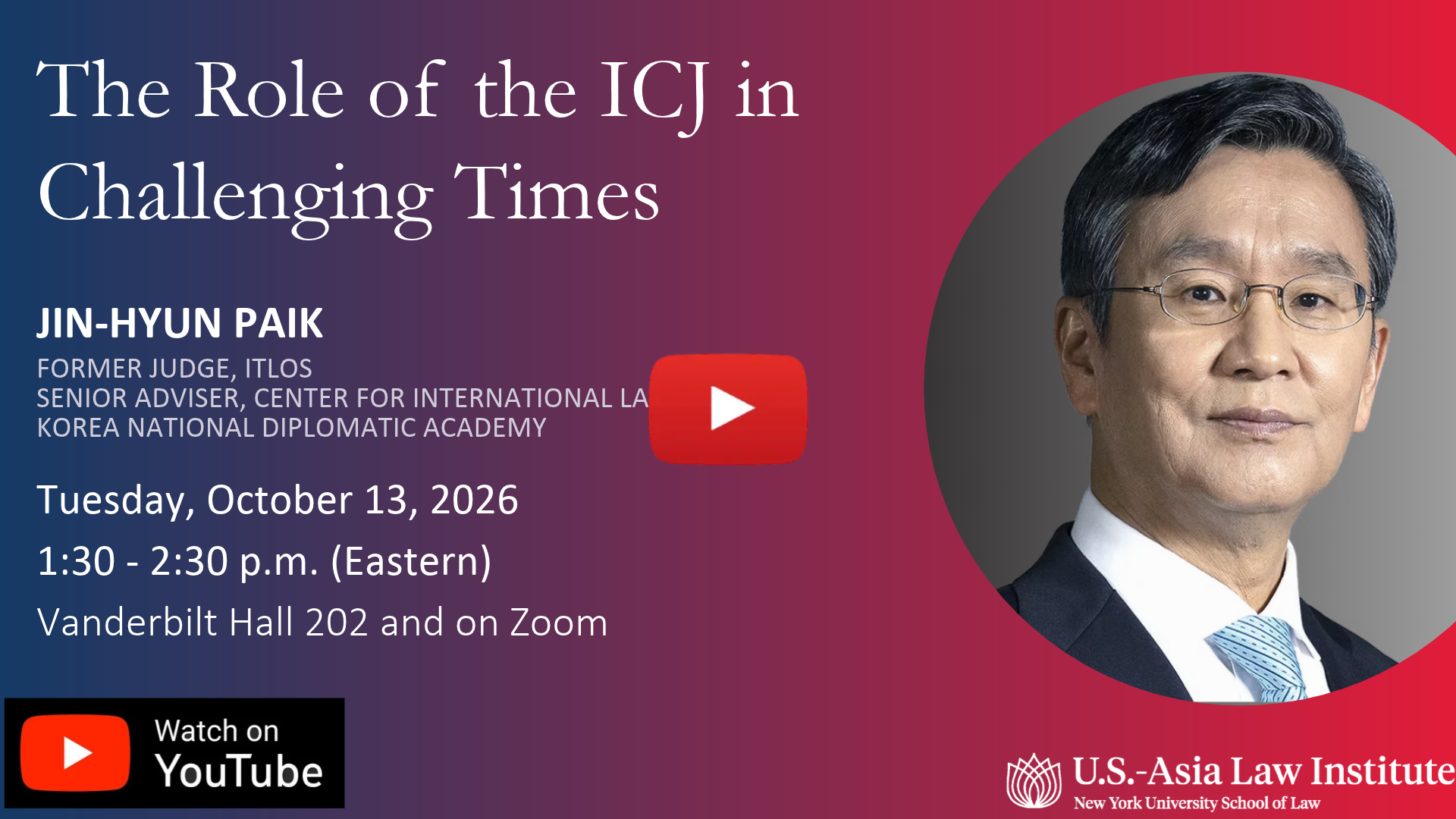
In recent years, amid intensifying geopolitical tensions and conflicts, the effectiveness of international law and particularly the UN Charter’s obligation that all states settle their disputes peacefully is widely contested. The International Court of Justice (ICJ), by contrast, has attracted more litigants than ever before as well as high profile requests for advisory opinions that have drawn the participation of unprecedented numbers of states seeking to participate in the judicial process. While the world’s attention focuses on the election of a new UN Secretary-General, the same political organs responsible for that selection – the UN General Assembly and Security Council – are engaged in electing or re-electing a number of judges to a Court that is now seen as the favored international venue for ‘strategic litigation.’ One of those candidates, Paik Jin-Hyun, a former president of the International Tribunal for the Law of the Sea (ITLOS) and an experienced arbitrator for international disputes, will share his views on why the judicial interpretation of international law remains popular when that law is itself under severe challenge.
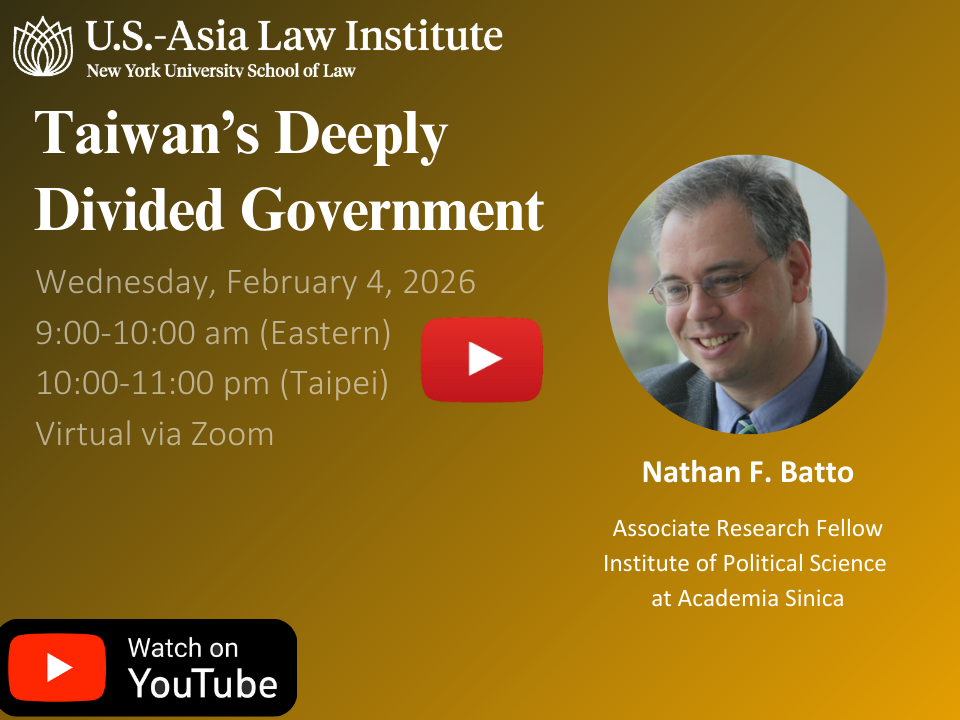
Ever since elections in 2024 gave the presidency to one party and the legislature to its rivals, Taiwan’s political arena has been the scene of non-stop drama. When the Nationalist Party and its ally in the legislature tried to expand their power to oversee the executive branch, the Constitutional Court ruled them out of line and the legislature responded by shutting down the court. When the Democratic Progressive Party-led executive branch claimed power to exercise a pocket veto of legislation it didn’t like, the opposition in the legislature began a process to impeach the president even though they lack the numbers to achieve their goal. Nathan Batto, an associate research fellow at the Institute of Political Science in Taiwan’s Academia Sinica and expert on Taiwan’s elections, will explain how Taiwan’s government structure, political culture, and other factors have contributed to the current crisis, how the Taiwanese public is responding, and the possible impact on Taiwan’s delicate international standing.
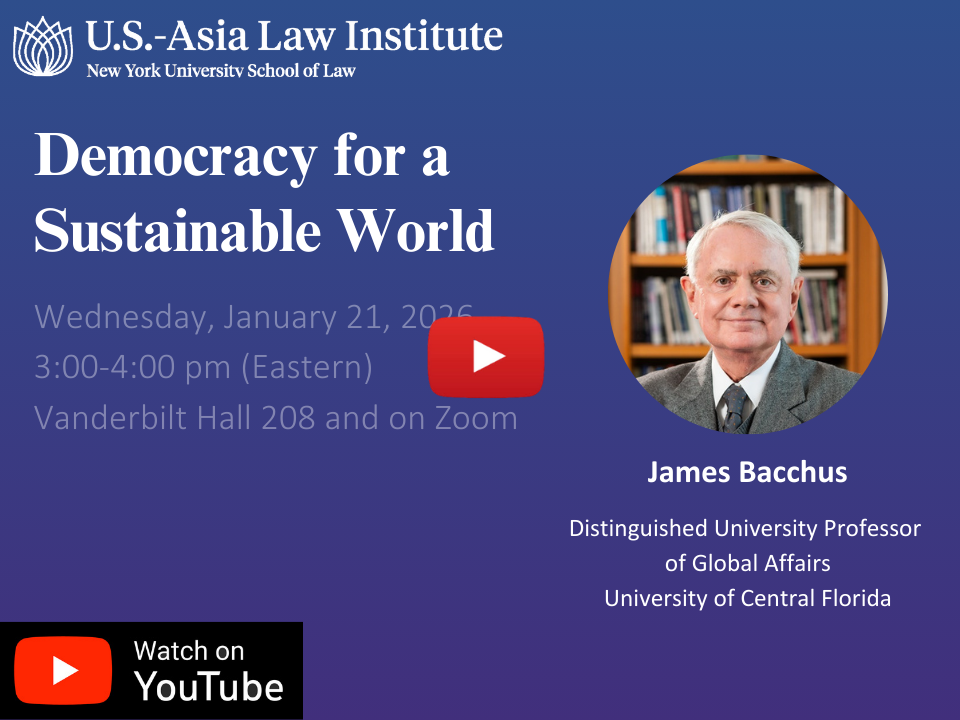
The path to global sustainable development is participatory democratic global governance – the only truly effective path to confronting pandemics, military conflict, climate change, biodiversity loss, and potential overall ecological collapse. So says James Bacchus in his new book, Democracy for a Sustainable World: The Path from the Pnyx. Bacchus argues that global democracy and global sustainable development can only be achieved jointly. Beginning with a visit to the birthplace of democracy in ancient Athens, a hillside called the Pnyx, Bacchus explores how the Athenians practiced democratic participation millennia ago. He draws on the successes and shortfalls of Athenian democracy to offer specific proposals for meeting today’s challenges by constructing participatory democratic global governance for full human flourishing in a sustainable world.

Since the Chinese government carried out full-scale privatization of the urban housing market nearly three decades ago, private home ownership in cities has soared and tens of millions of home-owning Chinese have joined home ownership associations. In his new book, The Authoritarian Commons: Neighborhood Democratization in Urban China (Cambridge University Press, 2025), Shitong Qiao argues that homeowner associations (HOAs) have fundamentally changed how Chinese urban neighborhoods and cities are governed. Drawing on six years of fieldwork, he finds that local governments have come to rely on homeowners to help govern their own neighborhoods, and homeowners have become accustomed to the democratic ritual of electing HOA leaders. Does the rise of HOAs have any wider significance for China’s political future?

China’s legal service sector is growing rapidly, including not only commercial law offices but publicly funded legal aid and innovative free legal advice platforms. At the same time, the regime has largely suppressed the country’s human rights lawyers. What is going on? Hualing Fu, dean of the law faculty at the University of Hong Kong and visiting professor at NYU School of Law, will share his research into an emerging new sector that he calls “public legal services,” which the party-state is developing in order to ensure that social disputes are resolved speedily in line with regime interests. In the process, Chinese lawyers may be transitioning backward from legal professionals to state legal workers.

The Constitutional Courts of South Korea and Taiwan have been thrust into the spotlight in recent weeks as they are asked to arbitrate bitter power struggles between the elected branches – power struggles in which the justices themselves have been targeted. Two eminent constitutional scholars – Chaihark Hahm of Yonsei Law School and Jiunn-rong Yeh of National Taiwan University – will explain the background to the current crises and reflect on the role of courts in protecting democracy at times of deep partisan divisions.

The National Security Law, which was imposed on Hong Kong in 2020, takes precedence over local law and has profoundly affected civil liberties and the right to fair trial. Does international law no longer matter in Hong Kong? Carole Petersen, professor of law at the University of Hawaii at Manoa, finds that in cases not affecting Beijing’s core interests, local judges still rely on international and comparative sources and still rule against the local Hong Kong government. This has been particularly evident in strategic litigation to advance the rights of the LGBT community. Petersen concludes that if the local government is serious about trying to rebuild Hong Kong’s international reputation, then it should accept and fully implement these rulings.

The U.S.-Asia Law Institute kicks off its 2024-2025 programs by taking a close look at a problem right here at home: racial profiling of Asian Americans, including at universities. During the Trump administration, the Department of Justice created the China Initiative, a program presented as safeguarding universities and businesses from economic espionage. In practice, it raised widespread concerns of racial profiling of Chinese American and immigrant academics and researchers, many of whom were accused of failing to disclose routine academic activities – but not of espionage or national security breaches. Although the program ended in 2022, there are ongoing efforts to revive it. The Asian American Scholar Forum (AASF), a new civil rights advocacy organization created in response to the China Initiative, reports that Asian American researchers and scholars continue to face bias and heightened scrutiny in their working and living environments. AASF Executive Director Gisela Perez Kusakawa will discuss the current challenges faced by Asian American researchers, scholars, and students from Asia, the chilling effect this has, and the need for legal scholars to help develop innovative solutions to the tensions between national security and American values.

When compared with other constitutional courts, Japan’s Supreme Court has often been dismissed as a timid institution. It has even been called “the most conservative constitutional court in the world.” Masahiko Kinoshita, a professor of law at Kobe University and leading constitutional law scholar, argues that this sells the court short. In a new paper, he says that in cases involving freedom of expression, voting rights, and representation, the court has protected the “democratic minimum core” values while strategically avoiding confrontation with the political branches.

Ensuring women’s property rights has long been seen as essential to ensuring their enjoyment of other human rights, from personal safety to economic development. The expert committee that interprets and seeks to enforce the Convention on the Elimination of All Forms of Discrimination against Women (CEDAW) has over the years developed a unique body of jurisprudence interpreting the convention’s requirement that women enjoy property rights equal to those of men. What is surprising is that this jurisprudence – which encompasses the right to contract, administer property, access credit and government benefits, make use of agricultural land, access adequate housing, and more – has received very little attention from scholars. Law Professor José E. Alvarez, director of the U.S.-Asia Law Institute at NYU Law School, will explain what he calls CEDAW’s “progressive property jurisprudence.”

In 2019, the world was transfixed by the sight of normally tidy, peaceful Hong Kong wracked by months of massive protests. At stake was Hong Kong’s future, in which many youth had lost hope. Journalists Shibani Mahtani and Timothy McLaughlin will tell the story of the protests and immediate aftermath mainly through the eyes of four participants, drawing on their new book, Among the Braves: Hope, Struggle, and Exile in the Battle for Hong Kong and the Future of Global Democracy.

Since 2017, Japanese women have come forward one after another to publicly share their experiences with sexual harassment. Their bravery has made a difference: In 2020, Japan passed a law requiring large companies to take steps to prevent workplace harassment. Last summer, the penal code was revised to raise the age of consent to 16 and make it somewhat easier to prosecute accused rapists. Kazuko Ito, founder and vice president of Human Rights Now and a lawyer, will talk about the recent efforts to combat sexual harassment in the larger context of the women’s rights struggle in Japan. Questions to explore include the effectiveness of the recent legislative changes and what more needs to happen.

The women’s movement in the Republic of Korea has been one of the most active and impactful in the region. South Korea joined CEDAW in 1984 and ratified its optional protocol in 2006. The Ministry of Gender Equality and Family has led important reforms. But women activists are now facing a severe backlash, and the ministry itself is under attack. Korean feminist activist OH Kyung-jin will discuss the history and development of the women’s movement, the role played by CEDAW in its achievements, and the factors that have produced the current backlash against women’s rights activism.

The Convention on the Elimination of All Forms of Discrimination Against Women (CEDAW) is one of the most widely embraced international conventions, ratified by 189 states including states in East Asia. But what impact has it had on the actual lives of women in East Asia?

Earlier this year, China’s Communist Party orchestrated yet another reorganization of party and state organs, resulting in some party and government entities being merged (合并) or joined (合署). The move follows an even more extensive institutional shakeup in 2018. Meanwhile, the party under Xi Jingping’s leadership continues to encroach on government functions in more subtle ways as well.

联合国《消除对妇女一切形式歧视公约》(CEDAW)是唯一一部全面保障妇女人权和防止性别歧视的国际条约。负责监督成员国落实、履行公约的机构名为联合国消除对妇女歧视委员会。众所周知,委员会的主要任务是跟进成员国在妇女权利方面取得的进展;而鲜为人知的是,通过发布各种文件,委员会也在积极阐释、发展CEDAW的规则体系。

Mike Chinoy, a former CNN Beijing bureau chief, will talk about his new book, Assignment China, an oral history of American journalists who reported on China from the Communist revolution of 1949 through the COVID-19 pandemic.

Recent developments in the United States and Asia make this a good time to examine the state of women’s rights protection, with a particular focus on the interplay between domestic and international law and norms.

Harassment and violence directed at Asians and Asian-Americans has surged since the start of the COVID-19 pandemic. Jennifer Wu (NYU Law 2004) and Lawrence Wee, partners at Paul, Weiss, Rifkind, Wharton & Garrison LLP, have stepped up to provide pro bono legal representation for victims of Asian hate crimes, including some of the most vicious recent attacks.

Divorce rates in China have risen sharply over the past three decades, as socioeconomic transformations have reshaped family life and gender relationships. Assistant Professor Ke Li of John Jay College of the City University of New York will discuss her book Marriage Unbound: State Law, Power, and Inequality in Contemporary China.
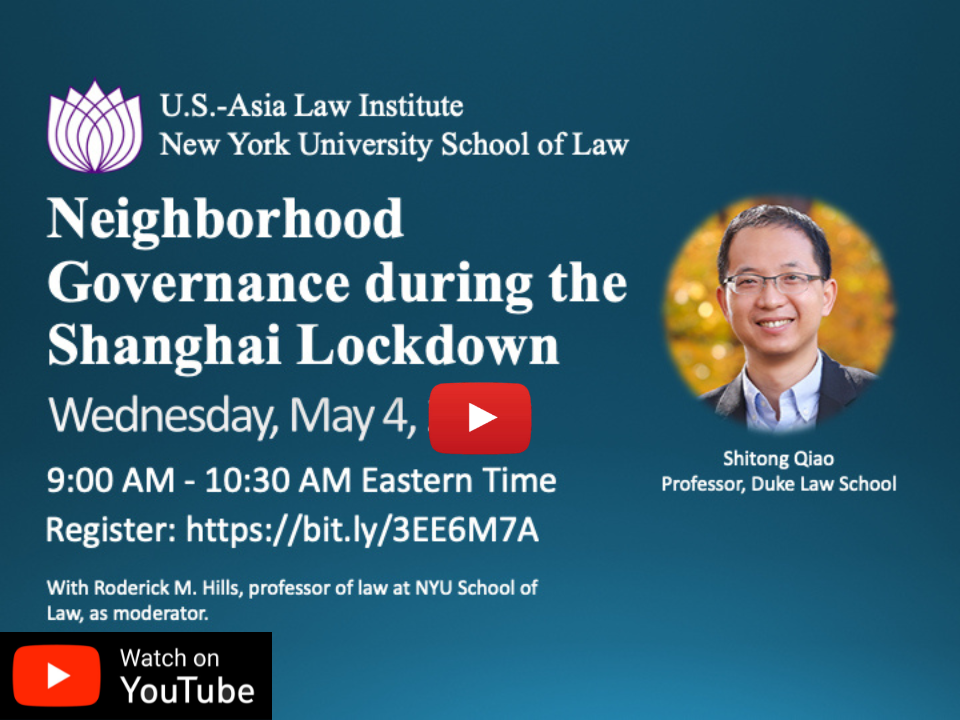
Building on his research into neighborhood governance in urban China, Professor Shitong Qiao will discuss grassroots governance during the Shanghai COVID-19 lockdown, including the emergence of spontaneous cooperation among residents at the neighborhood level and the regulation and self-regulation of resident groups.
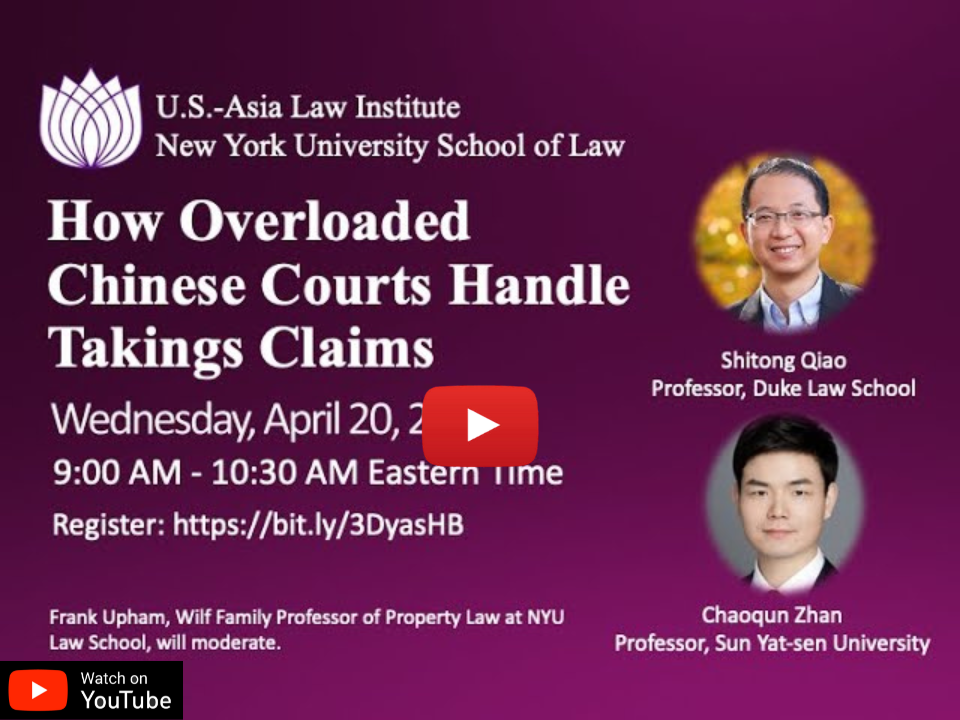
The 2015 revision of China’s Administrative Litigation Law caused an explosive increase in courts’ workload, including a surge in Chinese citizens suing local governments over property expropriation. Professor Shitong Qiao of the Duke School of Law and and Professor Chaoqun Zhan of Sun Yat-sen University, will share their research into how that surge affected court decisions.
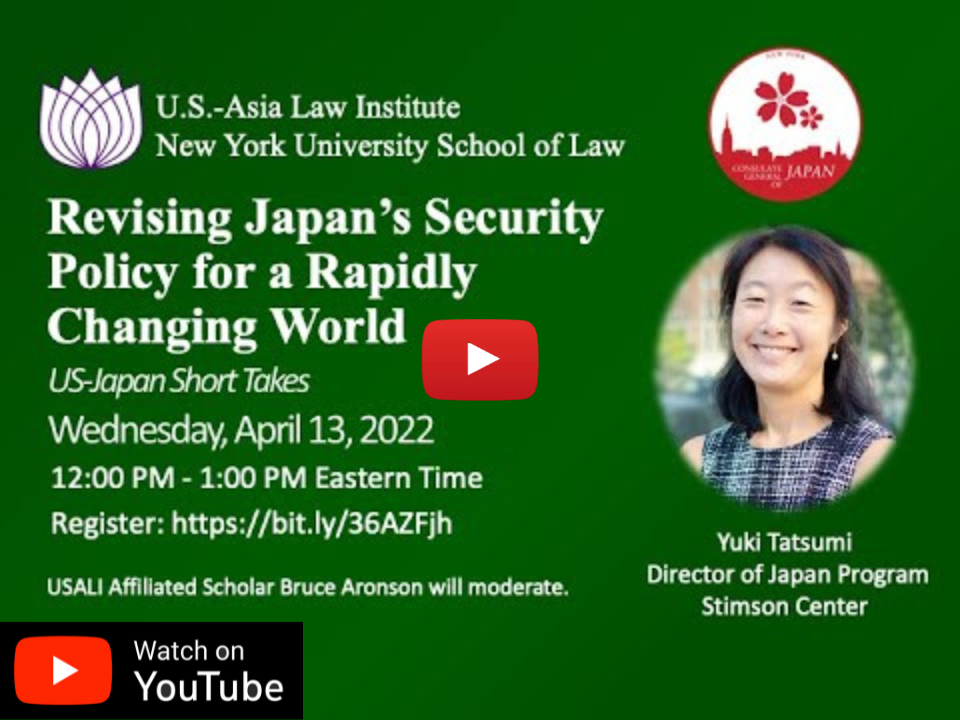
Yuki Tatsumi, director of the Japan Program at the Stimson Center in Washington, D.C., and a leading expert on Japan’s security policy, will discuss how recent events are affecting the process of revising Japan’s National Security Strategy and the likely direction of its new security policy.

Carole J. Petersen is professor of law at the William S. Richardson School of Law, University of Hawaii at Manoa.