Taiwan’s 23 million people believe they are a distinct people. What they can’t agree on is how best to stay that way.

The chairwoman of Taiwan’s Nationalist (Kuomintang) Party, Cheng Li-wun, has a message for Americans: Taiwan should not be the next Ukraine. Rather, Taiwan should reconcile with China and seek to carve out some kind of autonomy within “the great Chinese nation.”
Cheng’s two-week US speaking tour from California to Washington, D.C., comes only a few weeks after Chinese Communist Party leader and President Xi Jinping delivered a stern warning to President Donald Trump to handle Taiwan “prudently.”
Translation: stop selling weapons to Taiwan.
Cheng says her message is different. She says that the Kuomintang (KMT) – the dominant party in the legislature and a fierce adversary to Taiwan President Lai Ching-te of the Democratic Progressive Party – supports a strong defensive capacity for Taiwan. But she argues that true security can only be achieved by establishing a relationship of trust with authorities in Beijing through a process of mutual confidence building consisting of exchanges and dialogue. In essence, Cheng says Taiwan must persuade China that it does not need to attack because Taiwan is not a threat.
In essence, Cheng believes Taiwan must persuade China that it does not need to attack because Taiwan is not a threat.
Cheng is vague about the exact steps to entente with China. She does not claim that Xi Jinping offered any concessions when she met him in Beijing on April 10, an event billed as a meeting of two Chinese party leaders. In fact, she told NPR that they did not even discuss unification. But she says that China would permit Taiwan to maintain its own democratic political system for as long as Taiwanese want, as long as they accept that they are part of one China. She told an audience at the Asia Society in New York on June 8 that Taiwan’s people are innovative enough to figure out a framework for autonomy that will produce a better outcome than the formula of “one country, two systems” applied in Hong Kong, which she conceded has almost no support in Taiwan.
The problem with this approach for many of Cheng’s American interlocutors is that the People’s Republic of China has been crystal clear about its goal of absorbing Taiwan into the Chinese state. The reactions from several of members of Congress with whom Cheng met suggest they were not persuaded. Rep. Tom Suozzi, a Democrat, reportedly said in a statement after meeting Cheng that the KMT’s “resistance to a robust defense budget raises concerns for me that the party is drifting closer” to Beijing and “weakening deterrence.” In May, the KMT joined with a smaller party to slash by nearly 40 percent, from US$40 billion to $24.8 billion, a special defense budget intended to purchase American weapons and build up an indigenous drone and weapons industry. The KMT said the budget was insufficiently transparent and it preferred to allocate funds in smaller amounts as needed. Speaking to domestic audiences, however, Cheng also has framed US arms purchases as wasteful “protection money.” Unsurprisingly, she was much more polite during her US visit.
Taiwan’s voters also have doubts about the KMT approach. Is Taiwan safer if it befriends the bully or arms itself against the bully? A My-Formosa poll conducted shortly after Cheng’s meeting with Xi found that just 37.6 percent of respondents believed the meeting would “help prevent war across the [Taiwan] Strait and safeguard Taiwan’s status and overall interests,” while 51 percent believed it would not be helpful. More broadly, while more than half of respondents said dialogue with China could reduce hostility, more than a third said it could leave Taiwan in a weaker position. Some other polls reported a slightly more positive assessment of the Cheng-Xi meeting but still found high levels of skepticism about the likely success of dialogue. A 2023 Pew Research Center poll found that even among KMT supporters, 52 percent saw China as a major threat to Taiwan and only 16 percent thought China was not a threat.
Is Taiwan safer if it befriends the bully or arms itself against the bully?
By contrast, President Lai’s vision for securing Taiwan’s future is to turn Taiwan into a “porcupine” so heavily armed that an attack would be extremely costly. Urged on by the Trump administration, Lai has called for increasing Taiwan’s military spending to five percent of GDP by 2030, approximately double its 2024 level. He wants to build an AI-equipped air defense system called the Taiwan Dome, build up a domestic industry to produce air and sea drones, and develop responses to China’s growing use of “gray zone” measures such as cutting undersea cables and conducting frequent military drills in the seas and sky around Taiwan. Lai also wants to reduce or blunt the effect of pro-Chinese messaging in Taiwan’s traditional and social media; root out Chinese espionage, which has especially targeted Taiwan’s military; and foster civil defense preparedness among the broad population.
Lai’s strategy, like Cheng’s, gets mixed reviews in Taiwan. Slightly more than half of respondents to a poll in April by scholars Lev Nachman and Wei-Ting Yan expressed support for his original special defense budget. But members of the public generally respond negatively to anything that smacks of political censorship, including anti-disinformation measures. Many worry that a heightened defensive posture is itself destabilizing and invites Chinese retaliation. Finally, there is persistent worry that no matter how heavily armed Taiwan becomes, it is too small to fend off China should Xi or his successor choose to take action. Confidence that the United States would be willing to shed blood in Taiwan’s defense is low.
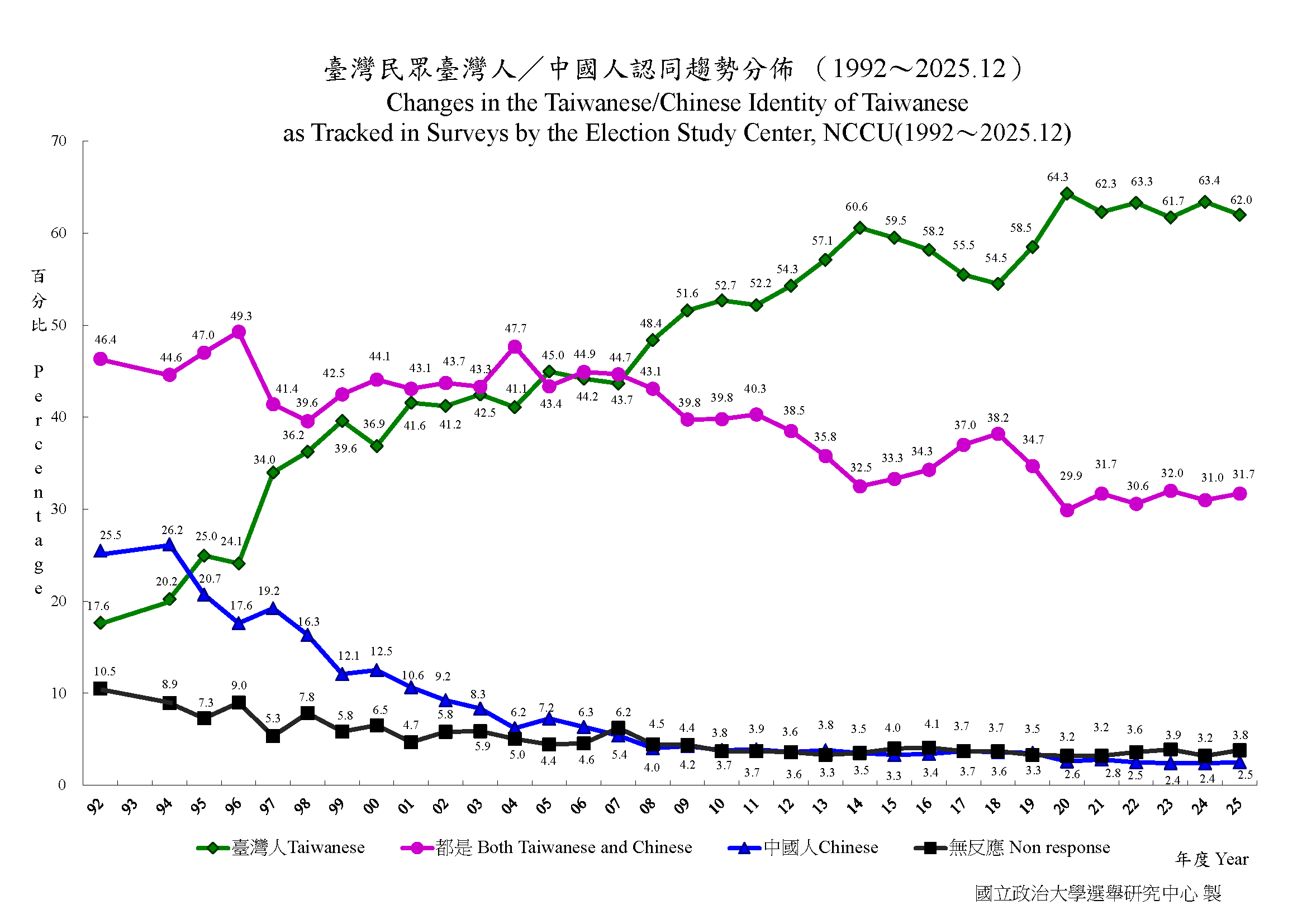
Opinion polls in Taiwan are plentiful and detailed, a feature of Taiwan’s open and democratic system. Digging into them reveals the dilemma of people who feel they have no good choices. Ever since 2014, more than 60 percent of respondents have told the National Chengchi University Election Study Center that they identify as Taiwanese, not as Chinese. Almost one-third say they identify as both. When Cheng Li-wun told US audiences that Taiwan is part of the “great Chinese nation,” she seems to have been speaking for the 2.5 percent of the population that identifies only as Chinese.
What seems to unite Taiwanese more than anything else is their self-identification as Taiwanese.
But at the same time, only a small minority of Taiwanese favor taking steps to formally claim statehood separate from China. That is obviously because they fear Beijing would respond with military force, not because they like living in “strategic ambiguity,” to use Washington’s label for its own policy toward Taiwan.
Since 2024, when Beijing responded to Lai’s election by ramping up its threat posture, domestic politics in Taiwan have become polarized to the point of dysfunction. Cheng, while calling for reconciliation with Beijing, has only shrill rhetoric for the DPP, which she denounces as “malign” and “fascist” — the latter echoing Russian President Vladimir Putin’s label for Ukrainian President Volodymyr Zelensky. The KMT-controlled Legislative Yuan has rejected wholesale Lai’s agenda, including not only his special defense budget but his proposed government operating budget and appointments to the Constitutional Court and critical independent agencies such as the election commission (see Yinn-Ching Lu’s Perspectives essay on Taiwan’s zombie government). This government gridlock to some extent just mirrors the deep uncertainties and distrust in the population because of the vise in which it has been placed.
What seems to unite Taiwanese more than anything else is their self-identification as Taiwanese. This gets consistently more unified poll responses across the entire population than questions about the usefulness of dialogue versus buying more weapons. Taiwan’s 23 million people believe they are a people. What they can’t agree on is how best to stay that way. Should they befriend the bully or arm against the bully? Understandably, they are torn. This division may prove to be their greatest vulnerability.
***
Katherine Wilhelm is executive director of the U.S.-Asia Law Institute and an adjunct professor at NYU School of Law.
Suggested Citation:
Katherine Wilhelm, “Taiwan’s Existential Choice: Dialogue or Arms,” USALI Perspectives, 6, No. 10, June 15, 2026, https://usali.org/usali-perspectives-blog/taiwans-existential-choice.
The views expressed in USALI Perspectives are those of the authors, and do not represent those of USALI or NYU.
This work is licensed under a Creative Commons Attribution-NonCommercial-NoDerivatives 4.0 International License.